
DRAFT Andrews Community Forest
Andrews Community Forest (ACF)
This page is about the ACF - information about the ACF management committee is HERE (add new link).
Table of Contents
Andrews Community Forest
Welcome!
Visiting
Parking
Rules and Guidelines
Recreational map
What You Can See in the ACF
Ecological Studies, History, Reports and Observations
A video from the Vermont Master Naturalists program
Video - ACF Wildlife Habitat
Powerline Operations
Other Information
Maps
Forestry Management Plan
Forestry Maps
Welcome
The Andrews Community Forest is part of one of Vermont’s largest remaining expanses of interior forest and highly ranked for its own biodiversity and ecological integrity. The Town of Richmond was able to acquire it thanks to the generosity of the Andrews family, who for decades had owned and cared for the forest and surrounding farmland. The Town also had tremendous assistance from the Vermont Housing and Conservation Board, the Vermont Land Trust, Richmond’s Conservation Reserve Fund, and many private donors. In 2018 the Town conserved it for its “landscape connectivity and natural resource, recreational and aesthetic values.” The Forest is managed by the Town’s Andrews Community Forest Committee.
The Andrews Community Forest is located within Ndakinna (in-DAH-kee-NAH), the homeland of the Western Abenaki people, who have a unique connection to this land and have been its traditional stewards for millennia. For many generations before the European colonists arrived, the Abenaki people harvested animals, nuts, plants, berries, fiber, and timber in these forests, without degrading their ecological health. More details: t3://file?uid=16799Proposed Indigenous Land Acknowledgement and Use Agreement
Visiting
Parking
Please park in the Community Forest parking lot by Route 2 and not on the adjacent private property. Respect the privacy of the neighboring homes and businesses.
Rules and Guidelines
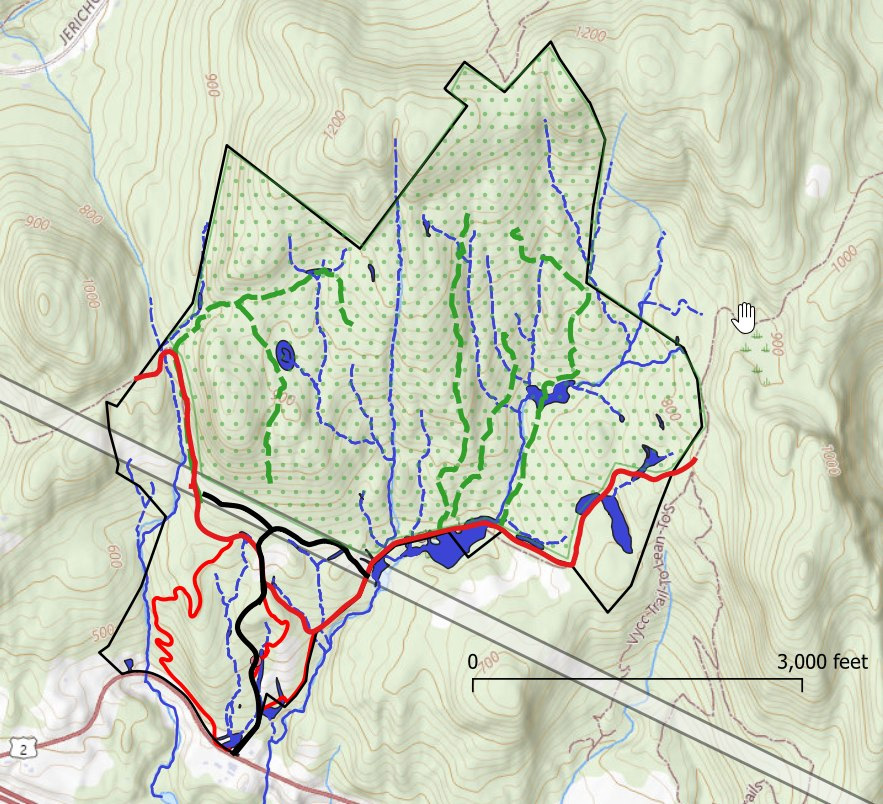
The Forest is open to the public from 4 am to 10 pm for a wide range of recreational activities. The parking area is 1.1 miles east of the traffic light in Richmond Village. Ticks are abundant - so be sure to check for them after you leave. Biking is permitted on designated trails – please check and download the map below – see information posted at the kiosk by the parking area. Hunting is also permitted per State regulations. Dogs are only allowed in the southern zone (See Recreational Map below and details at Trail Finder.) Keep pets on a leash. Avoid disturbing wildlife or livestock. Remove all pet waste.
Sharing the Forest
While the entire ACF is open to the public, visitors should keep in mind that utilities and a local farm also have the right to use certain forest roads and trails to reach their facilities. Logging and other forestry management operations may be encountered. Please be careful around these activities and avoid them when you can.
Recreation Map
Download the ACF Recreational Map
What You Can See in the ACF

iNaturalist Map
The Andrews Community Forest’s terrain, its uncommon natural communities, and largely unfragmented, undisturbed interior expanse make it a wildlife hotspot. The map above, from the ACF project site in iNaturalist, gives an indication of the number of plant and animal observations people have made across the forest. (Be sure to use ACF’s iNaturalist project site to record your own sightings!)
Birds abound in the ACF, from its high hemlock canopies to the bushes and brambles in open areas along trails and old logging roads. Spring and fall bring an extra bonanza of migrant stopovers. You might see a bear, bobcat, fisher, moose or coyote – or, more likely, their tracks, scat, tree scratches and scrapings, and other signs. White-tailed deer are active throughout the ACF. Frogs and salamanders live in the Forest’s streams, wetlands and vernal pools, filling the latter with masses of tadpoles each spring.
The ACF’s biodiversity and unfragmented acreage has attracted the attention of many naturalists, biologists, botanists, ornithologists, ecology students and other professionals. Their assessments provide us with the information we need to care for the forest and its wild inhabitants. Amateur naturalists play an important role as well, filling in the fine detail of what lives in the Forest. Apps like iNaturalist and eBird will help you identify and learn more about the plants and animals you see. The sightings you can log on them will help us in managing the Forest for wildlife and people alike.
Species Typical of its Natural Communities

Ecological Studies, History, Reports and Observations
- Vermont Land Trust Baseline Documentation Report (2017)
- Audubon Vermont Forest Bird Habitat report (2017)
- UVM Field Naturalist Program study and recommendations (2019)
- Arrowwood Environmental Reports (2021) (2022)
- From Farm to Forest, an overview of the Forest and its human history, by Angus Bisgard Cummings
A privately maintained library with a wide range of public information about the Forest, assembled as with input material offered by community members.
Additional Maps
- Biodiversity Rankings – ACF’s standing and contributions to its 70,000-acre forest block (Vermont Conservation Design)
- Natural Communities (Arrowwood Environmental) – Unique assemblages of plants essential to ACF biodiversity and wildlife viability
- VLT Ecological Protective Zones
- Heat Map – Areas of the ACF color-coded to show their sensitivity to habitat disturbances (UVM Field Naturalist Program)
Exploring the ACF with Master Naturalists

A video from the Vermont Master Naturalists program
The ACF comes alive in this video, “Tracking Wildlife in Winter at Andrews Community Forest,” that puts you on the trail of the Forest’s bears, bobcats, porcupines and other species.
Ecological Forestry in the ACF

In this video, Ethan Tapper, former County Forester, discusses programs to improve the ACF’s biodiversity and forest resilience Andrea Shortsleeve of the VT Department
Further Information including Ecological Studies, History, Reports and Observations
Maps
- Biodiversity Rankings – ACF’s standing and contributions to its 70,000-acre forest block (Vermont Conservation Design)
- Natural Communities (Arrowwood Environmental) – Unique assemblages of plants essential to ACF biodiversity and wildlife viability
- VLT Ecological Protective Zones
- Heat Map – Areas of the ACF color-coded to show their sensitivity to habitat disturbances (UVM Field Naturalist Program)
Forest Management Plan
The ACF’s Forestry Management Plan is built on the principles of “ecological forestry,” which uses practices such as the careful harvesting of trees to emulate the natural disturbances that foster greater biodiversity and forest resilience. It also covers the ACF’s place and contributions to its 70,000-acre forest block – one of the state’s highest-priority blocks – as well as wildlife habitat, water management, recreation, invasive species control and other topics. It describes the Forest’s division into three zones, each with its own management approach.
Since the Forestry Management Plan was adopted, several acres have been harvested. Some of the wood was sold, with proceeds going to the Forest’s management fund. Other wood was milled and stored on site, for use in picnic tables, information kiosks and other infrastructure. Firewood was donated to a local non-profit that makes it available for little or no cost to disadvantaged families and individuals.
Forestry Maps
Learn About the ACF Management Committee
ADD LINK to COMMITTEE PAGE